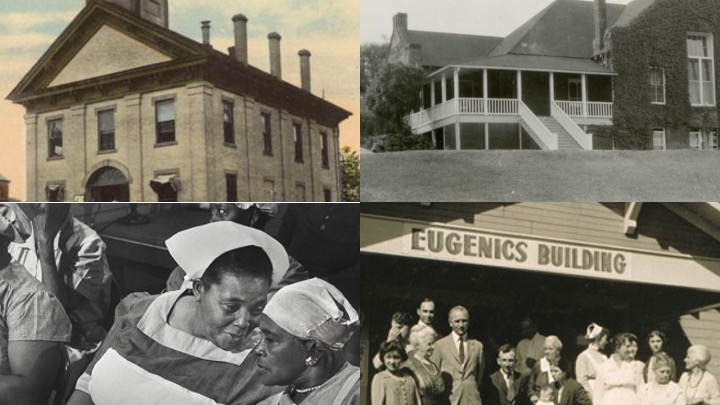
Disability, Medicine, and Expertise
In the U.S. the founding president of Stanford University, David Starr Jordan, wrote and taught his theory of ‘dysgenic breeding,’ that argued the nation had wasted its best and brightest in World War I. Meanwhile, in the U.K. Francis Galton’s work on ‘hereditary genius’ in the 1860s, argued that famous artists, athletes, and thinkers were evidence of inherited physical and intellectual gifts. His 1883 Inquiries into human faculties and its development included the first appearance of the word ‘eugenics,’ a coinage drawn from the Greek for well-born. Jordan, Galton, and others were part of a growing conversation across social, political, economic, and scientific domains that saw people in terms of “breeding stock” or “economic burden,” and that rejected longstanding traditions of religious and community charitable organizations.
While there was strident opposition to eugenic practices throughout the twentieth century, prominent figures like Jordan and Galton provided the impression that Darwinian and Mendelan insights about plant and animal genetics could be leveraged to support biases against certain religious groups, like Catholics, and immigrant communities, including those from Ireland, Mexico, African countries, and east Asia and create a new science of human betterment. Together with early twentieth century prejudices against women, people with disabilities, queer people, and people experiencing poverty, these ideas were woven together in a net designed to capture people that eugenicists considered “unfit.”
Historian Paul Lombardo observes that while political affiliation doesn’t easily map onto the legislators that proposed sterilization laws, nor the governors who did or did not sign such legislation into law, the input of medical (including psychiatric) doctors and surgeons was particularly important in states where eugenics thrived; “physicians,” he notes, “were among the most fervid supporters of eugenic laws.”[1]
[1] Paul Lombardo, “Republicans, Democrats, and Doctors: The Lawmakers Who Wrote Sterilization Laws,” Journal of Law, Medicine, and Ethics 51, No. 1 (2023): 123–130.
This page has paths:
- Critical Themes in the History of Eugenics Gianna May Sanchez