What We Can Say with Data
A small number of people who are represented in our data may have truly undergone sterilization voluntarily, perhaps because they did not have access to birth control. The United States Supreme Court did not recognize the right to contraception for married people until Griswold v. Connecticut (1965) and those rights did not extend to unmarried people until the Eisenstadt v. Baird decision in 1972. Prior to Griswold, in fact, many states made it illegal for doctors to prescribe contraception and in some states even discussing contraceptive methods was prohibited. In these contexts, voluntary eugenic sterilization may have been a path to reproductive autonomy for some people.
That said, the vast majority of the people sterilized were not asked, they were coerced or simply forced. Our modern federal right to informed consent was only established in 1986 (after three important legal cases in 1972: Canterbury v Spence, Cobbs v Grant, and Wilkinson v Vesey).1 Our contemporary consent guidelines require physicians to be sensitive to and mitigate possible professional or social pressure, but no such regulation existed during the time of legal eugenic sterilizations. In some cases, the only way that patients were able to leave a hospital was by consenting to and undergoing sterilization. In others, there is evidence of arguments that sterilization would solve perceived behavioral and intellectual problems. The people subjected to eugenic sterilization weren't seen by doctors or state officials as people worthy of their respect. Nor did those same officials seem to worry about the negative impacts of eugenic sterilization on communities.
Rather than replicate the historical harms of eugenic practices, we wanted to respect that eugenic survivors and their families may not want their particular stories out in the world - including on the internet. While many of our primary sources have aged out of federal protections for health information, we also knew that a significant proportion of the people represented in these data are either dead or very aged. While data visualization can be problematic when it removes valuable context or flattens depth, data storytelling also offers us one way to share some of the stories of eugenic sterilizations in the United States while also respecting the rights of the people represented therein.
To this end, and in collaboration with the Sterilization and Social Justice Lab, the Digital Justice Lab at Dartmouth has developed a number of data stories for our readers. Many of these are embedded within Eugenic States narrative paths. They are also collected here as a set.
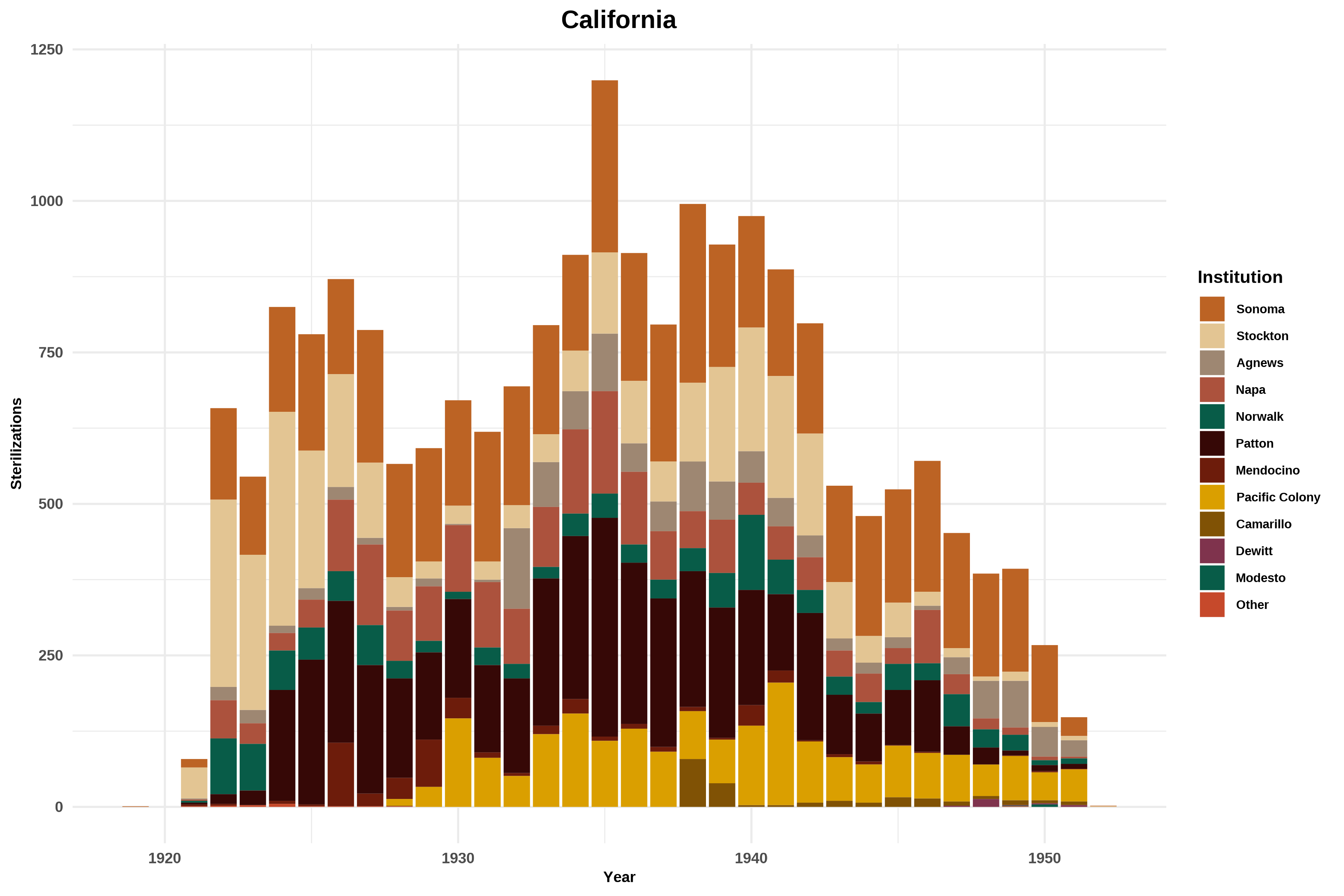
When reading/looking at these visualizations, please keep in mind that we can only visualize the data that we have. As a result, we emphasize in our captions and titles that these are visualizations created with data from *known* sterilizations. It is possible and perhaps even likely that there were additional sterilizations in the states covered here that were not recorded or for which the records are lost to us. Additionally, we have testimony that entities like the U.S. Government's Indian Health Services conducted sterilizations but we do not have access to those records. Rather than consider these visualizations as authoritative documentation of the full breadth of sterilization under eugenic laws, we encourage readers and viewers to consider them as representations of a partial historical record.
Clicking on a header like "Looking at Eugenic Practices Across the Nation" will take you to a page that gathers all of those visualizations together. To date, we have a full narrative for the multistate data and Brook Vann's excellent North Carolina 1920-1980 Data Zine. Our data storytelling work is ongoing as of August 2026 and we expect to finish soon!
1. Olejarczyk JP, Young M. Patient Rights and Ethics. [Updated 2024 May 6]. In: National Library of Medicine's StatPearls Available from: https://www.ncbi.nlm.nih.gov/books/NBK538279/
This page has paths:
- Introduction Jacqueline D. Wernimont